And it seems to me you lived your life
Like a candle in the wind
Never knowing who to cling to
When the rain set in
And I would've liked to known you
But I was just a kid
Your candle burned out long before
Your legend ever did...

Elton John, Candle in the Wind, 1973
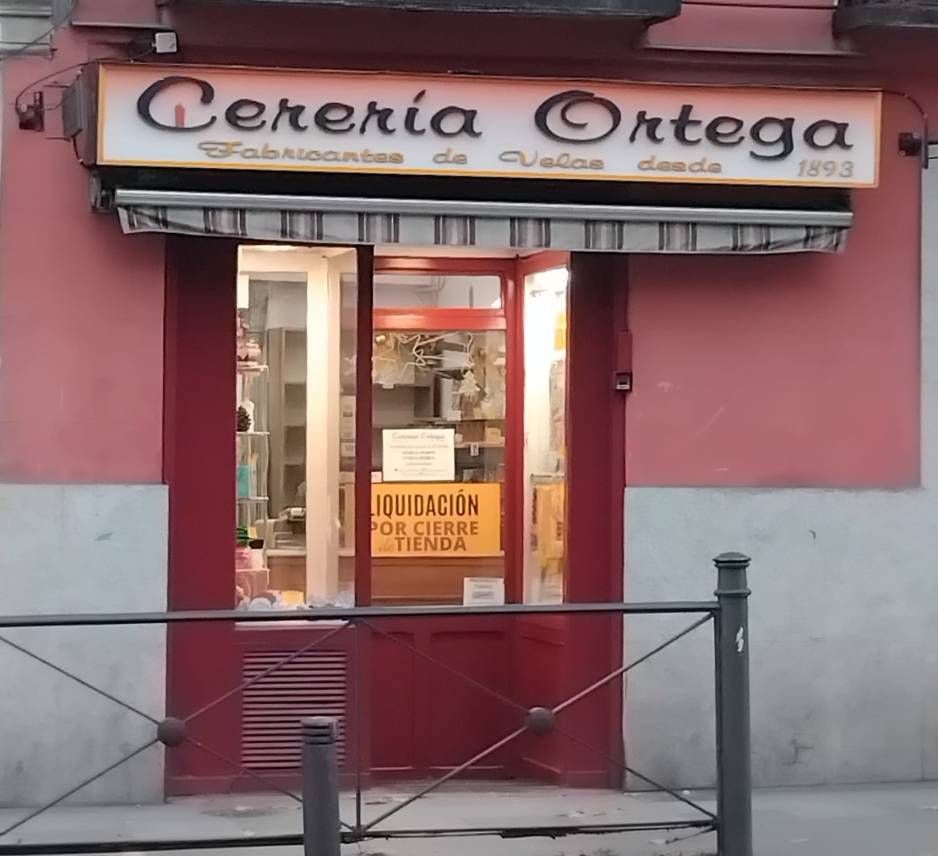
The shelves in the last chandlery in Madrid are mostly empty. The wax creations that once lined the walls of Cerería Ortega have disappeared faster than a packet of lemon creams in a library since the announcement of its upcoming closure. Liquidación Por Cierre reads a yellow sign in the window. Twisted candles shaped like enormous unicorn horns, multicoloured globes, cubes, and cones, small candles in the form of hats and cars and roses, beeswax candles, candles covered in rosemary, cinnamon-scented candles, ornate white and gold candles for communions and weddings, long, thin candles for Easter processions– all gone, after 131 years in business. But the shop’s usually gruff owner, Silvia, is all smiles these days. More on that later.
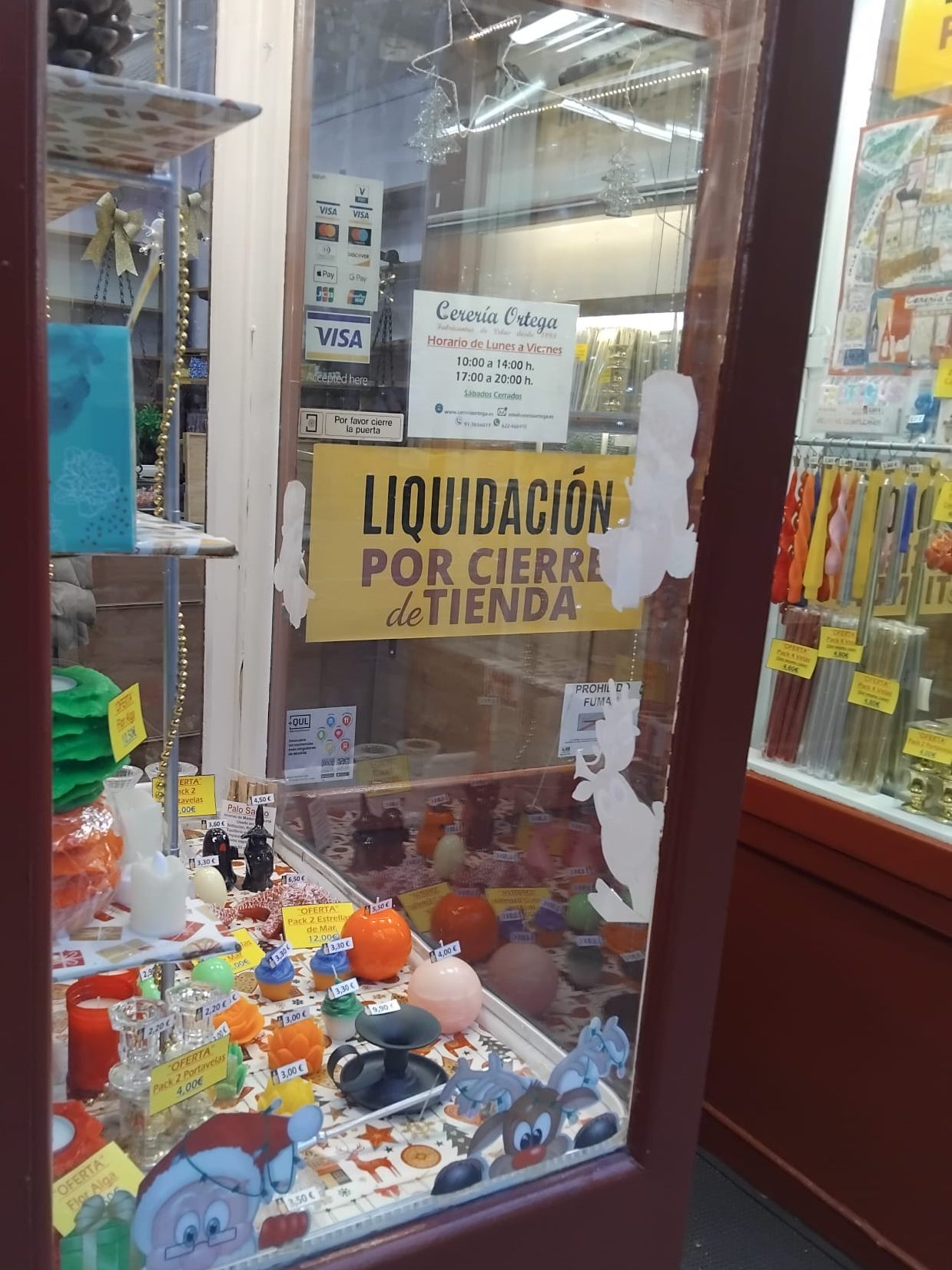
On my way to the cerería for what is likely the last time, I try to think of something clever to ask her so I can include it in this piece. I also try to work up the courage to ask if I can take pictures. When I arrive, I do neither. Taking photos of empty shelves might vex the soon-to-be former shop owner, and Silvia’s quiet joy is far too lovely to interrupt with impertinent questions I have already read the answers to in newspapers. How long has she been working at the shop? 11 years, but the business has been in her husband’s family for four generations. Why are they closing? Low sales over the last few years, despite her best efforts to hold down the fort. Cut to a picture of Silvia standing behind the counter, smiling.
History presents us with many candle adjacent inventions (such as ricepaper wicks covered in insect wax and seeds in early China, resin-coated strings of flax used in Ancient Rome, and the Nisga’a people’s halimotkw or “saviour fish”, which are reportedly so oily they can burn like candles when dried) but one of the earliest indications of candles we have on record is a clay candle holder unearthed on the east bank of the Nile, which dates back to the 4th Dynasty (ca. 2575-2130 BCE). Most of the candles used during this time were probably similar to rushlights – rush plant pith soaked in grease – which appear in works of literature as late as Jane Eyre (1847):
“The next day commenced as before, getting up and dressing by rushlight; but this morning we were obliged to dispense with the ceremony of washing; the water in the pitchers was frozen.”
Jane Eyre, Chapter VI, Charlotte Brontë
Rushlights can be burned at both ends to provide more light for shorter periods of time. The origin of the idiom ‘burning the candle at both ends’, or brûler la chandelle par les deux bouts, is usually attributed to this fact. First recorded in A Dictionarie of the French and English Tongues in 1611, the meaning of this phrase has shifted over time. Originally used to refer to spendthrifts, its modern definition, which, as I understand it, is something like working hard and playing even harder, is exemplified in Edna St. Vincent Millay’s poem First Fig (1920):
My candle burns at both ends;
It will not last the night;
But ah, my foes, and oh, my friends—
It gives a lovely light!
But a few literary mentions can’t hold a candle to the symbolism of candles in the art world. In Vanitas still lifes from the 1500s and 1600s, snuffed candles allude to the transient nature of human existence. In Dziewczyna z gromnicą (Girl with the Thunder Candle) by Teodor Axentowicz, the candle is a testament to a young Hutsul woman’s piety as she trudges through the snow on Candlemas Day. For Gerard Richter, an East German artist who creates photorealistic paintings of candles, the candle has a different meaning altogether.
“Candles had always been an important symbol for [East Germany],” he explains, “a silent protest against the regime…”
Industrialised candle production began in the 1830s, and by the end of the century, London-based Price’s Candles, which holds a royal warrant to this day, was the largest candle manufacturer in the world. However, demand declined after the commercialisation of incandescent light bulbs in the 1880s.
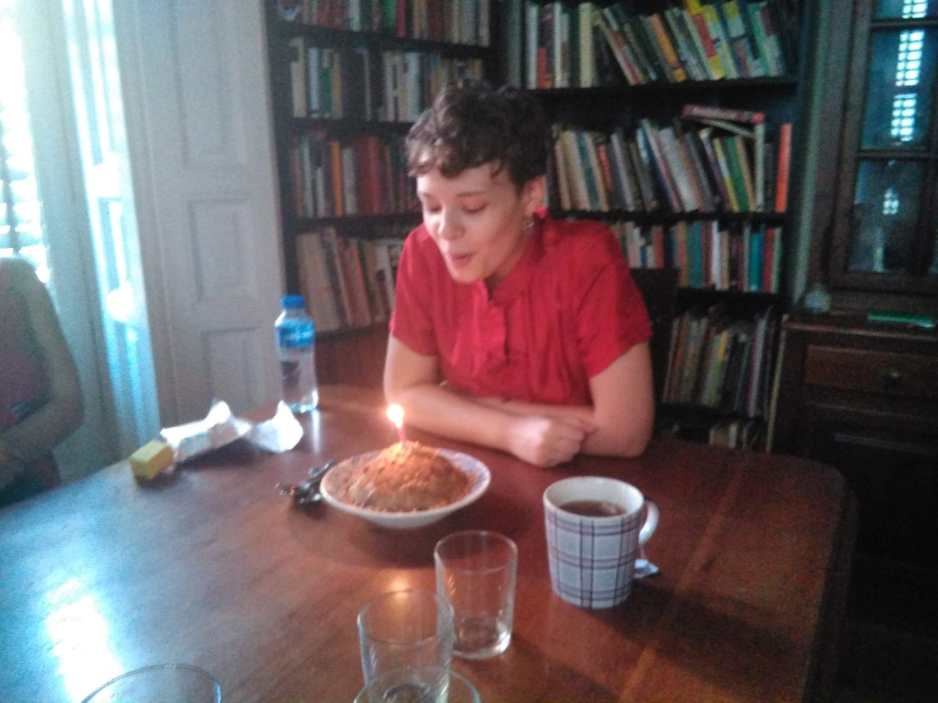
Despite this, candles still form part of everyday life across the world. They can be used to set the mood, decorate dining tables, line bathtubs and light up birthday cakes, a tradition rooted in Ancient Greece, where round cakes were decorated with candles to resemble shining moons in honour of Artemis, the Goddess of the Moon and the Hunt.
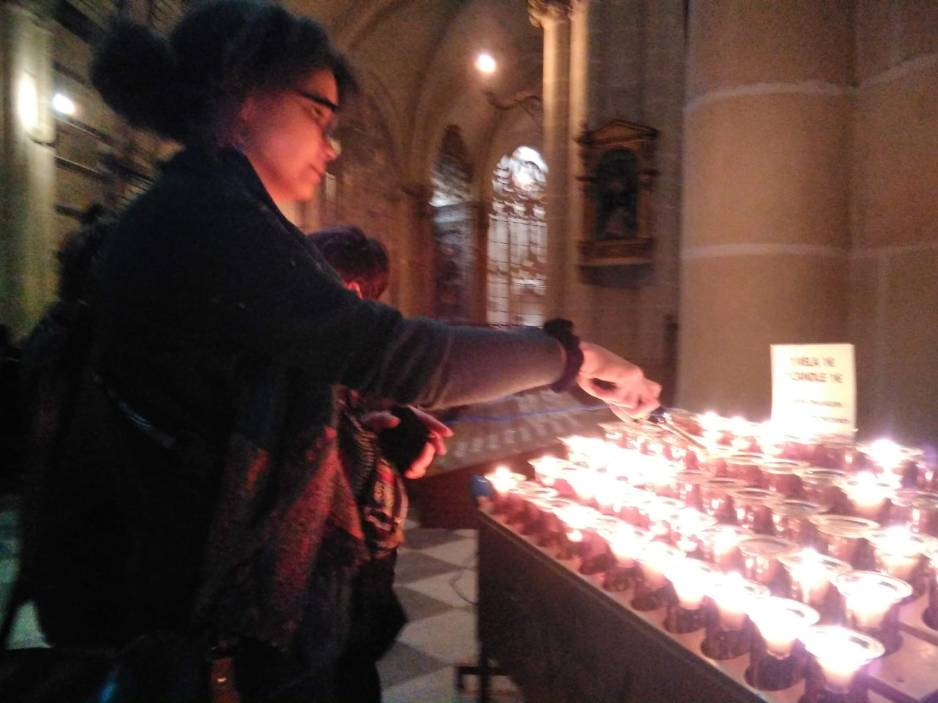
Candles are also a prominent part of numerous religious ceremonies, including Diwali, the Day of the Dead, Hannuka, Christmas, and Little Candles Day celebrated on the 7th of December in Colombia, where candles burn under the night sky across the country.
The utility of candles extends to repairing shoelaces, sealing envelopes and, if they contain citronella, repelling mosquitoes. Esoteric stores, such as El Alquimista on Calle Magdalena, even offer candles promising love, health, money, good luck, and protection.
“How far that little candle throws his beams! So shines a good deed in a weary world.”
The Merchant of Venice (Act V, Scene 1).
But that little candle casts a long shadow. At 150°C, the minimum temperature required to liquify paraffin wax, volatile compounds are released, causing dizziness, nausea, lung irritation, and eventually liver and kidney issues. Molten wax burns, chemical fragrances, and toxic colour pigments containing heavy metals are additional risk factors for candlemakers. Suddenly, Silvia’s smile isn’t so cryptic after all. I could ask her about the health risks associated with her family business and whether or not they had anything to do with her husband’s recent retirement. Instead, I choose to focus on the Christmas light hanging in her window display, a shooting star that flashes on and off, and how it plays with orange streetlights and the light slowly leaving the sky. As I purchase my last batch of unicorn horns, our eyes meet. Ting-a-ling-ling chimes the shop bell. Words begin to form in my mouth, but Silvia’s gaze shifts to the next customer. I make my way towards the door with my unusually loud puffer coat.
“Hasta luego,” she cries as I step outside, but we both know that is a lie.
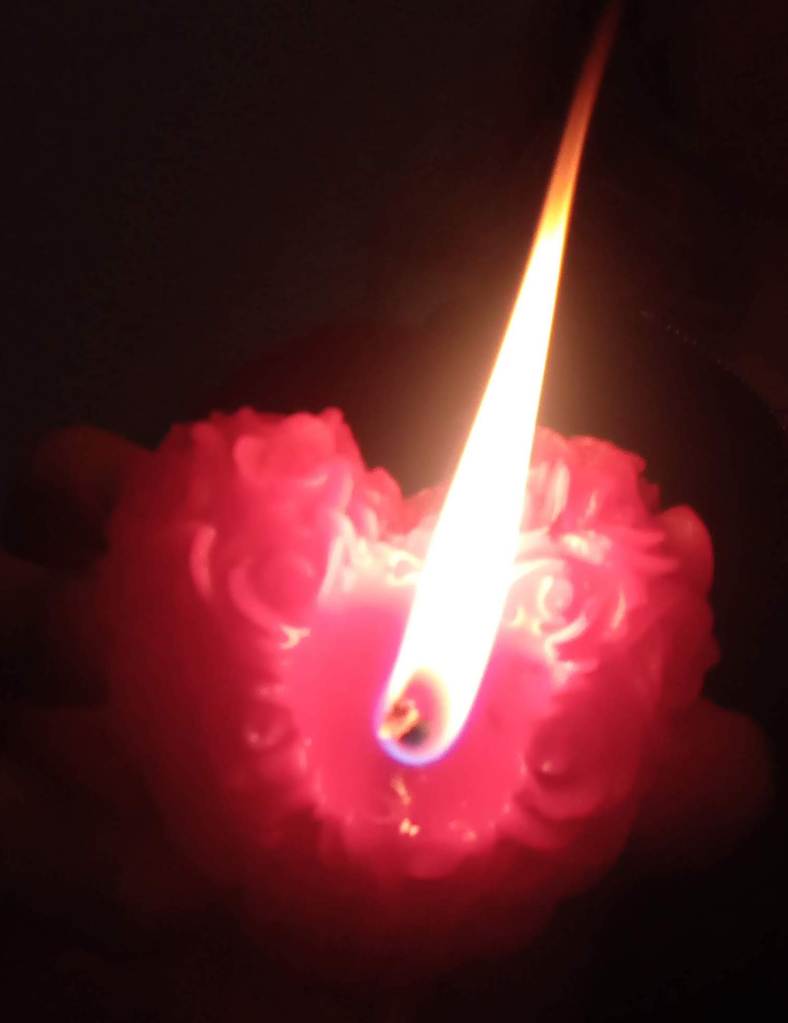
La Cerería Ortega sold its last candle on Thursday, 5 December 2024.



 Madrid en Poesía
Leave a comment